



Grand Prix Goes to “Palestine 36″; Closing Film: “Hamnet”
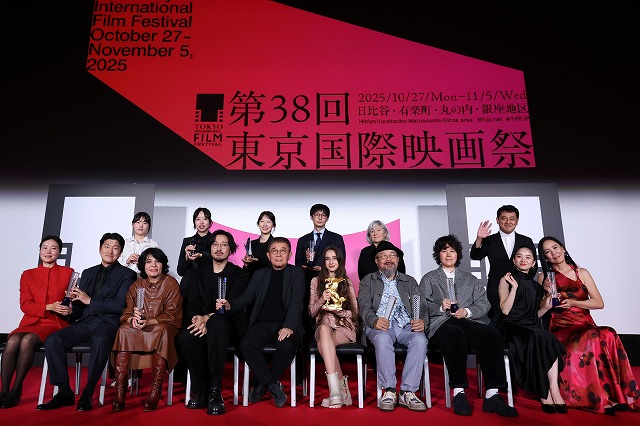
©2025 TIFF
TIFF’s 38th Edition Concludes with Tributes to Film’s Power to Bridge Divides
The 38th Tokyo International Film Festival (TIFF) concluded on November 5, following 10 days of screenings and events at the festival’s venues in the Hibiya-Marunouchi-Yurakucho-Ginza area. TIFF screened 184 films, nearly all of them with guest appearances, with 69,162 admissions and another 163,009 audience members attending related events.
Among the many highlights of this year’s festival were a thronged Red Carpet opening event, masterclasses with Soi Cheang and Peter Ho-sun Chan, an Opening, Closing and Centerpiece film that featured women protagonists, TIFF Lounge talk sessions between today’s leading creators, and enriched international exchanges.
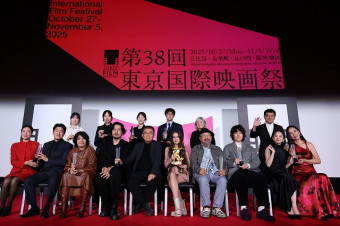
During the Closing Ceremony at Toho Cinemas Hibiya, recipients were announced for a range of awards, culminating in the Tokyo Grand Prix, The Governor of Tokyo Award, which comes with 3 million yen in prize money.
The 38th Tokyo International Film Festival Closing Ceremony
Date: November 5 (Wed.), 2025, 5:00 pm – 6:40 pm
Venue: TOHO Cinemas Hibiya, Screen 12
Host, Presenters and Guests:
Award Winners (Please see list below)
Competition Jury Members: Carlo Chatrian / Gwei Lun-Mei / Matthieu Laclau / Saitoh Takumi / Vivian Qu
Asian Future Jury Members: Ellen Y.D. Kim / Matsunaga Daishi / Nishizawa Akihiro
Asian Students Film Conference Jury Members: Rithy Panh / Christian Jeune / Okamoto Tao
Closing Film, Hamnet: Chloé Zhao (Writer, Director, Editor and Producer)
Special Guest: Vice Governor of Tokyo: Koike Yuriko
Chairman of the 38th TIFF: Ando Hiroyasu
MC: Michael Rivas
The 38th Tokyo International Film Festival Press Conference with Jury and Award Winners
Date: November 5 (Wed.), 2025, 7:00 pm – 8:30 pm
Venue: LEXUS MEETS․․․
Speakers:
Competition Jury Members: Carlo Chatrian / Gwei Lun-Mei / Matthieu Laclau / Saitoh Takumi / Vivian Qu
Award Winners: Rithy Panh / Teona Strugar Mitevska / Award: Alex C. Lo / Zhang Lu / Wang Chuanjun / Fukuchi Momoko / Kawase Naomi / Sakashita Yuichiro / Roh Young-wan
The 38th Tokyo International Film Festival Award Recipients
[Competition section]
Tokyo Grand Prix, The Governor of Tokyo Award: Palestine 36 (Palestine/UK/France/Denmark)
Special Jury Prize: We Are the Fruits of the Forest (Cambodia/France)
Award for Best Director: Alessio Rigo de Righi and Matteo Zoppis (Heads or Tails?, Italy/USA)
Zhang Lu (Mothertongue, China)
Award for Best Actress: Fukuchi Momoko and Kawase Naomi (Echoes of Motherhood, Japan)
Award for Best Actor: Wang Chuanjun (Mothertongue, China)
Award for Best Artistic Contribution: Mother (Belgium/North Macedonia)
Audience Award: Blonde (Japan)
[Asian Future section]
Asian Future Best Film Award: Halo (Korea)
[Asian Students’ Film Conference section]
Best Film Award: Floating (Korea)
Special Jury Prize: Forever and a Day (Taiwan) / Reviving the Engine (Korea)
TIFF Ethical Film Award: White House (Brazil)
Kurosawa Akira Award: Lee Sang-il / Chloé Zhao → Official Report
Lifetime Achievement Award: Yamada Yoji → Official Report / Yoshinaga Sayuri
【38th Tokyo International Film Festival Numbers】(Preliminary figures)
Total number of audience / number of films screened:69,162 admissions / 184 films *10 days
(Last year, 37th: 61,576 admissions, 112.3% / 209 films, 88.0% *10 days)
% of films by female directors and co-directed by male and female directors: 23.4% (43 in 184 films)
Other official events:93,847 admissions(last year: 96,886 / 96.9%)
Events with the guest appearance: 184 (last year: 178 / 103.4%)
International guests: Approx. 2,557(last year: 2,721 / 93.9%)
Closing Ceremony: Comments from the Jury members and Award Winners
[Asian Students’ Film Conference: Special Jury Prize]
Okamoto Tao, Jury member
Many of the entries were amazing and we enjoyed viewing them. We agreed and were convinced regarding the results. The entries that were not selected were also unique, and we hope the directors will bring their films to TIFF again and other festivals in the future.
Chen Li-Hsuan, National Taiwan University of Arts (Forever and a Day)
I come from Taiwan and I would like to thank the festival for this opportunity and this award. This film features something that is probably happening somewhere around the world today, and I would like to draw the audience’s attention to it so that someday, it will never happen.
Jung Hye-in, Korean Academy of Film Arts (Reviving the Engine)
I was so surprised to win this award and I have no idea what to say. But I would like to thank my team who created this film with me. And I would like to also thank my teachers at KAFA, for all their support.
[Asian Students’ Film Conference: Best Film Award]
Rithy Panh, Jury President
We spent time to watch many good films, and the jury unanimously fell in love with this film. The Asian Students’ Film Conference Grand Prix goes to Floating by director Lee Ji-yun.
Lee Ji-yun, Korean Academy of Film Arts (Floating)
I was not expecting this, but I feel very happy to receive it. It’s such an honor to screen the film in the cinema. Thank you very much. This started from my personal experience. I had many questions about the American Dream. I would like to express my gratitude to all my team and all the teachers at KAFA. I would like to conclude with this line, also in the film, ‘Never give up, continue to film!’
[Asian Future section: Best Film Award]
Ellen Y.D. Kim, Jury member
It’s been a truly special privilege to serve as a jury member. With my fellow jury members, we watched 10 great films that were astonishing in their diversity, sensitivity and creative energy. Many works impressed us with their originality. Some focused on marginalized lives with breathtaking intimacy, while others explored the delicate layers of human psychology. I was reminded of how vivid and powerful the future of Asian cinema is. I would like to express gratitude to all those who contributed their work and to TIFF for this experience.
Roh Young-wan (Halo)
I didn’t expect to receive this award. This is my first international film festival, and I thought there would be a notice about the award on a day before the announcement. As I didn’t hear anything yesterday, I drank a lot last night. I want to thank all those who helped, the cast and the crew. Today my wife and producer Kim Eun-na is here and it’s her birthday. I’m so glad I can share this award with her. Thank you very much to the jury, the programmers and TIFF Chairman Ando.
[TIFF Audience Award]
Sakashita Yuichiro (Blonde)
It’s such an honor to be accepted by such a large audience and to receive the Audience Award. I’ll do my best to come back again to the festival.
[International Competition]
Carlo Chatrian, Jury President
First of all, we want to thank Chairman Ando, Programming Director Ichiyama and the entire staff of the festival for taking such good care of us. We have been confronted with a selection that highlights how wide the spectrum of cinema is. However difficult our work may have been, we have tried to respect this diversity as we think that in a general landscape that pushes for ever-greater standardization, this is an important achievement. Despite our different backgrounds and personal tastes in cinema, we are happy to say that all decisions were the result of a general consensus and the main awards have been given unanimously.
[Award for Best Artistic Contribution]
Vivian Qu, Jury member
For an unexpected depiction of a historical character, strikingly portrayed by an actor always able to captivate the audience, this film is led by precise editing and enhanced by the use of nonconventional music.
Teona Strugar Mitevska (Mother)
Thank you. The jury speaks about pushing boundaries and that’s all I’m about. It’s taken me to turn 50 as a woman to have the audacity of an 18-year-old boy, but I have arrived. I hope this film will empower women. (Raising her trophy) Power to us! Thank you!
[Award for Best Actor]
Gwei Lun-Mei, Jury member
Within a limited narrative space, this actor created a convincing character through subtle and relaxed acting. He lived the role from beginning to end. As one of the most promising actors of this generation, the Award for Best Actor goes to Wang Chuanjun for Mothertongue.
Wang Chuanjun (Mothertongue)
I would like to take this opportunity to express my appreciation to TIFF, the members of the jury and the director, Zhang Lu. I am very low key and somewhere in the corner I’m trying to hide. I have a fear of standing out and I know that’s often misunderstood as arrogance. As I get older, I lose courage and the more I meet, the less I speak. Receiving this kind of award it something I’ve never dreamt of. I would like to thank actress Bai Baihe. Her performance is like light and because of her, I was able to come out of the darkness.
Chinese film will mark its 120th anniversary and I’m happy that this will become part of film history in China. Next week, the China Film Academy will mark its 80th anniversary, and receiving this award is a good way to honor my school where I studied. I would like to thank my wife and two daughters. My wife is an even better actor than I am. My apologies for speaking so long. Thank you very much.
[Award for Best Actress]
Saitoh Takumi, Jury member
Family as strangers. A mother and daughter who could not understand each other, or perhaps refused to try, caught between a terminal diagnosis and the birth of new life, slowly and sincerely drawing closer within their limited time, while confirming each other’s warmth. This year’s Competition section saw many heroines powerfully driving both film and narrative. Amidst them, the two women who devoted themselves to simply, quietly ‘being present’ stood out as particularly striking and memorable.
Fukuchi Momoko (Echoes of Motherhood)
Thank you. I played the protagonist in the film and it’s such a great honor to receive this award. In my hometown, through this important film, by taking part, being able to speak at this opportunity makes me nervous. The film was shot at this time one year ago, and I was trying to submerge myself in the role. The story was developed together with the director, Nakagawa Ryutaro. There were difficulties, but we overcome them thanks to the crew and also my castmates Kawase Naomi and Nakao Sachiyo. I had such a remarkable experience. I thank everyone who participated in the process. I don’t know what kind of actor I will be in the future, but I look forward to it.
Kawase Naomi (Echoes of Motherhood)
As a director, I took part in film festivals in the past and now I’m onstage as an actor, all thanks to Nakagawa Ryutaro. To the crew, to my fellow actors, thanks to them, I was able to exert all my energy. While it was difficult role to play, and I tried to be cold to Ms. Fukuchi while we were shooting, reflecting my character, but at last I could feel her weight and warmth. After Covid, the world is facing the reality of killing each other, but at TIFF we are putting film at the center. We should continue to cherish our lives.
[Award for Best Director]
Vivian Qu, Jury member
Through the urge to find our inner voice, the director creates an original dialogue between the characters and the city involving the present and the past time.
Zhang Lu (Mothertongue)
Earlier, my team member Wang Chuanjun received the Best Actor Award and he wasn’t smiling at all. I’m also not good at smiling, but I’ll try my best. I would like to thank the members of the jury for appreciating my work. I would also like to thank the actors and other team members, everyone involved. The director’s award can never be won by one person. This is an award for the entire team. As a filmmaker, we all know that without them, the director is just a fool.
To bring more smiles to the audience, I would like to talk about a TV crew from a few decades ago. On the stage, there was a leader and below him, many people were seated. He asked one of them, ‘What is your strength?’ ‘I’m good at writing.’ The leader would say, ‘OK, you’ll be the scriptwriter.’ ‘I’m good at taking photos.’ ‘The leader would say, ‘You’ll be the cinematographer.’ One person had his head down and wouldn’t speak up. The leader asked him his strength, and he said ‘I’m not good at anything.’ ‘Okay, you’ll be the director.’ This leader understood the essence of what it means to direct a movie. I would like to pray for your health and continued success.
Matthieu Laclau, Jury member
Bringing back the western genre to Italy, and modernizing it by putting at its center a female character that doesn’t want to be forgotten by history, the filmmakers re-write the history of their own country.
Alessio Rigo de Righi and Matteo Zoppis (Heads or Tails?) *video message
Alessio: Hello everyone. We just arrived in Rome and we just learned we won the Best Director for our film. We are very happy.
Matteo: Super super excited. We are waiting to get our luggage, actually. Thank you to the Tokyo International Film Festival and to the jury for giving us this prize. It’s fantastic.
Alessio: Yes, it’s a true honor to win this award. And we had such a great time in Tokyo and were so happy to show our film there, about the reaction of the public. Thanks to the festival for inviting us, and to the jury to give us this wonderful award.
Matteo: Hope to get there soon. Ciao.
[Special Jury Prize]
Matthieu Laclau, Jury member
By focusing on a community that is striking to survive amidst its harsh deforestation and by giving them the words to express their concern about the loss of their tradition, this film gives continuity to a sense of cinema that stands always by the side of the resilient ones.
Rithy Panh (We Are the Fruits of the Forest)
Thank you to the jury. I’m very happy but a little bit lost in translation. (He spotted his French translator and switched languages.) I’d like to thank many people, especially producer Catherine Dussart, thank you for supporting me for all the long four years of making this film. Thank you to the Banong family who is in the film, they taught me to be humble and empathetic, and they’re very good people. They’re keeping their traditions in the forests.
[Tokyo Grand Prix, The Governor of Tokyo Award]
Carlo Chatrian, Jury President
Being moved by the emotional side of this film, portraying mostly unknown historical facts, and being enchanted by the representation of the beauty of a land that now looks like an open wound, the jury has unanimously decided to give the Tokyo Grand Prix, The Governor of Tokyo Award to Palestine 36.
Koike Yuriko, Governor of Tokyo
Tokyo is so proud to host this magnificent celebration of the art of cinema. We are ready to see the new stories that will be woven here in our city. At a time when the world faces unfortunate divisions, geopolitical tensions, and the immense challenges of natural disasters, cinema serves a powerful, essential purpose. Films bravely cross language and cultural barriers, acting as a crucial force that connects people to people. They offer a shared space to feel and heal the human heart—to explore our sadness, our agony, our happiness, and our pleasure.
I am also pleased to congratulate those involved in establishing the newly created Asian Students’ Film Conference section this year. It is inspiring to see so many bright students gathering from across Asia. I sincerely hope the innovative challenges and fresh perspectives shared in this conference will expand and inspire the future of filmmaking globally.
Today, we see clearly the messages that TIFF’s films deliver—messages that truly reach out to people’s hearts and deepen human connection. As a great cultural festival that champions both creativity and the diverse world of cinema, I have the highest hopes for the continued success and further development of the Tokyo International Film Festival. Thank you very much.
Annemarie Jacir (Palestine 36) *video message
Good evening, Tokyo. I have just returned home after spending several beautiful days at the film festival. Being in Japan, being in Tokyo for the first time, it was very special to share the film and to meet audiences there. I want to thank the festival for that, Ichiyama Shozo for honoring us, inviting us to be part of this festival and this selection, and now that I’m home, I have received this amazing news from the jury.
Thank you to all the jury for your support for choosing our film Palestine 36 for this award, it is really a great, great honor. And it means everything to my team and to myself, and all of us that have worked very hard to make this film and fight for this film to come to life. So sharing it and receiving this honor is a beautiful thing. Thank you. Thank you. Thank you. Arigato. Have a good evening!
Wardi Eilabouni (Palestine 36)
It’s a very great honor to be here in Tokyo tonight and to receive this wonderful and important award, it means so much to us. I want to thank the jury and the festival and everyone who supported Palestine 36. And I want to thank director Annemarie Jacir for choosing me for this iconic film.
[Closing Film]
Chloé Zhao (Hamnet)
Hi, I’m Chloé, I made this film and it’s going to be here! When I made my first four films, it was about going as far and wide as possible, to every corner of the world. In my 40s, I’m a different person and I’m interested in the internal landscape. You have nowhere to go but into yourself. It’s the underworld of the internal landscape that I was interested in. I think I mainly wanted to express grief, because it’s a very a natural part of the human experience. Impermanence is the natural state of the universe. Sometimes we forget we’re part of that cycle, and resistance to that causes our suffering. I was interested in what chemical powers we have to alchemize it. Grief can bring us together as much as joy can.
Most of you are storytellers, and the film celebrates the power of storytelling and art. Since the dawn of time, our ancestors have used storytelling to give meaning to the paradox of being human. How can we give our love when we know we’ll lose it one day? Your work is sacred, now more than ever, and I hope you’ll enjoy it.
Ando Hiroyasu, TIFF Chairman
We had over 160,000 audience members and I had a very enjoyable 10 days. When we cast our eyes to the world, it’s suffering from divisions and conflict, as Governor Koike said. In spite of that, international film festivals cross borders, bring us together to have a dialogue and deepen our understanding. We were happy to welcome 2,500 guests from overseas and have meaningful exchanges. I’m deeply grateful. Through such exchanges, I believe new friendships will be born.
Ticket sales surpassed last year’s revenues. For the first time in 40 years, we screened (Paul Schrader’s) Mishima. Tickets were sold out in less than 15 minutes and we were flooded with requests for additional screenings. We’re happy to say that there will be two additional screenings, on November 8th and 9th. Please check our website for all the details.
Last year and the year before, the hardworking volunteers were introduced onstage. But this year, since more than 500 staff members have been supporting the festival day in and day out, let me show you a glimpse of what they’re doing. These are the people who make TIFF possible. Thank you very much and we ask for your continued support.
Press Conference: Comments from the Jury members and Award Winners
Carlo Chatrian
I’m sure you’re all aware that the jury’s duty is not only to choose films but also to discuss them. We had a lineup that was very diverse, and by discussing them, discussing every day for each film, we’ve all come to understand each other better. All the decisions were shared decisions. It’s not about individuality, it’s about acting as a whole body. That’s very important for me. If you have questions, we’re very happy to answer them.
Vivian Qu
It’s been a very fulfilling experience to be on this panel at TIFF. We had 10 days of intense discussions and to be able to see how diverse filmmaking can be today, it was a thrilling experience. I learned a lot from our discussions and my fellow jury members. I was happy to see some great films from around the world. To be able to award only a fraction of them is lamentable.
Matthieu Laclau
It was a great privilege, and I really appreciated having this time to talk with you. Thank you.
Gwei Lun-Mei
I was very honored to be part of the jury. This year’s selection was very diverse. I want to express my appreciation to Jury President Carlo Chatrian, who led us through many discussions. I was able to deepen my understanding of cinema. If I have the opportunity to work with this wonderful panel again, I would really love to.
Saitoh Takumi
I would like to apologize, since most of you would love to be at the screening of Hamnet right now, but unfortunately this conference is at the same time. We swam together in the ocean of cinema for the past 10 days and I had a wonderful experience with my fellow jurors. We really hit it off and were on the same wavelength. It was a huge honor to work with them. When we discussed the films, we gave our honest opinions and were able to achieve a sense of harmony. When you talk about cinema, you think about how you feel when you see a film. We have different perspectives and you grow from that. Thank you very much.
(Q&A session)
Asked for further reasons that the panel had chosen Palestine 36 as the Tokyo Grand Prix winner, Chatrian noted, “The emotional side of the film, as well as the depiction of the beauty of the land, are two aspects. Cinema is always a mirror of society. But we don’t look for something we already know when we watch a film. Our decision was not just a political decision. We awarded it for its artistic value, meaning something that goes beyond the past and present, and stays forever. It is also a film that addressed me as a Westerner. It is about a land that is now divided, and because of the choices of the filmmaker, it’s told on the part of the victims, not on the part of the aggressors.”
A journalist wondered how they’d chosen the Best Actor and Best Actress awards, which “were given to personal films, rather than political.”
Said Chatrian, “In the selection, the number of male performances were fewer than female performances, and it was a tough decision. The main actor in Zhang Lu’s film (Wang Chuanjun) convinced us, although he wasn’t the protagonist.
For the female actors, we felt that the combination of the two actors (Fukuchi Momoko, Kawase Naomi) mixed together, was something much stronger.”
Gwei added, “We saw a lot of female characters, experienced actresses, in great performances. We had numerous candidates, but we pared them down to these two. I was very moved by their performances, they had this chemical reaction, sometimes a spark, portraying the dynamic of the movie and acting off each other. We all agreed that Wang Chuanjun’s performance was quiet and reserved, portraying the sensitive side of this character and his internal feelings.”
Tokyo Grand Prix, the Governor of Tokyo Award winner Annemarie Jacir (Palestine 36) was not present in Tokyo, but actor Wardi Eilabouni, appeared on her behalf.
She was asked about how the director had given her instruction for the ending scene, as well as how she hoped audiences at home would react to the film when it was released. “Annemarie always said to me, ‘Be you, not someone else.’ I had to imagine myself in that situation, and I was acting what I was feeling. I want audiences at home to feel happy, because this film is a hard film. It’s so painful, but the ending is supposed to be a happy ending.”
Director Rithy Panh (We Are the Fruits of the Forest) , winner of the Special Jury Prize, was asked how he thought his film was relevant for today. “In the film, you’re seeing a community that doesn’t have long to live,” he responded. “They’re in a state of extinction, the Bunong people. I wanted them to speak in their own language to allow me to be strictly an observer, watching them carry on their culture and traditions in the mountains. I wanted to show the way that rampant capitalism is ruining such communities. They live a completely different way of life and have a different world view, and I wanted to depict how they were encroached upon. When we encroach on communities like this, all of those in society are hurt. I think this is a very universal story that I’m telling.”
Director Teona Strugar Mitevska (Mother) , winner of the Award for Best Artistic Contribution, was asked about her depiction of Mother Teresa.
“I believe there’s a lack of female historical characters, female representation in cinema,” said the director. “Usually we’re eager to accept male historical characters in all their glory and failures, while female characters must be subdued. When I was making a documentary, Mother Teresa took me by surprise. I fell in love with her and decided to fill the void. The idea of this woman who lived almost 100 years ago, taking the world by the horns and figuring how to function very independently within a patriarchal structure, it is a very important example and I felt it should be put on the big screen.”
Fukuchi Momoko and Kawase Naomi (Echoes of Motherhood) , co-winners of the Award for Best Actress, were asked about the experience of working together. Said Fukuchi, “The director Kawase is very self-reflective, but in my collaboration with Ms. Kawase, certain elements of myself were pulled out of me. We molded each scene in a very nuanced, meticulous way. I’m very pleased to receive such an illustrious award. I would like to cherish the sensation of discovery as I progress on my career path.”
Kawase, who is a renowned auteur making her debut as an actor, noted that the role had come about because she had also directed Nakagawa Ryutaro, director of Echoes of Motherhood, in her own film, so that “it was an interdisciplinary collaboration, and that’s wonderful in a world that’s so divided. For us in the film industry to be able to cross borders is very promising. To receive a reward for my first-ever role is amazing, and I’m now very ambitious about pursuing further roles. TIFF is a wonderful festival, and I would like to dedicate this award to Ms. Kiki Kirin.”
Roh Young-wan (Halo) , Winner of the Asian Future Best Film Award, was asked about the inspiration for the young protagonist of his film, a delivery driver who is facing many challenges.
“I was in interested in this line of work, because delivery drivers in Korea connect us, make our life more convenient. We don’t pay much attention to these people, they’re invisible supporters. The situation of the Korean film industry after Covid was quite challenging, and I had trouble finding work. So Halo is also autobiographical. I always want to infuse ideas like this in my film work and tell stories about those who are outcasts, living in the shadows of society, and I’d like to eliminate those as much as possible.”
Director Sakashita Yuichiro (Blonde), Winner of the Audience Award, was asked whether he’d heard any international feedback for his film, a dramedy about Japan’s strict school rules. “Since I’m Japanese and this is a domestic film,” he admitted, “I had the Japanese audience members in mind when I was making this film. I was doubtful whether it would resonate with an international audience, but I received this award, so I suppose it did.”
Zhang Lu for (Mothertongue) , Winner of the Award for Best Director, was asked about the title and whether there had been a different reaction from Chinese and international viewers. Said Zhang, “There are various dialects in the film. We attempted to capture the divides between those who do and don’t understand those dialects. I must quite frankly say that I feel I couldn’t express this cinematically. But I think this is a universal theme that isn’t limited to China. It’s about language and how much we recognize or understand language.”
“A child first learns language from his or her mother, and when we return to our birthplace after going far away, we start to realize the importance of our mother, as well as how closely language is related to how we see the world. Language dictates the distance between two people.”
Told that his film had been one of the funniest of the Competition films, Zhang was asked about how he’d developed the humor. “I think humor is innate and came to us before language was birthed. Trying to figure out the relationship between the language we speak and a person’s physicality is what I was after. Sometimes communication falters and it’s the source of misunderstanding. It’s very interesting when there’s a discrepancy between the language we speak and the actions that accompany them. But I prefer humor that doesn’t constantly make you laugh, because then people would think you’re crazy.”
Asked about the relationship between Mothertongue and his other 2025 film, Gloaming in Luomu, which shares some cast and crew members, Zhang confessed, “When I shot the two films, I wasn’t aware of the connecting tissues. Part of the idea with Mothertongue was to capture the historic Sichuan Emei Film Studio, which was going to be razed, and I wanted to document it as they were deconstructing it — the films made there and the emotions created there. After I shot Mothertongue, I went on vacation to a very beautiful place and again, heard that it was being torn down and decided that I had to roll my camera right now. So it’s about encapsulating an ephemeral memory that’s going to fade away.”
Wang Chuanjun (Mothertongue) , Winner of the Award for Best Actor mentioned, “I come from Shanghai and I speak Shanghainese dialect. We have a saying that ‘people borrow light from others,’ and that’s what I did in this film, I borrowed light from my director and two costars. The director mentioned that I don’t easily smile, but now that I’ve received this wonderful award, I feel like I have a reason to smile and laugh.”
Producer Alex C. Lo, in Tokyo on behalf of directors Alessio Rigo de Righi and Matteo Zoppis (Heads or Tails?), Winners of the Award for Best Director, was asked about how the directors work, and said, “Matteo and Alessio are very different people, so it’s very interesting to see them work together. Matteo is the one with strong opinions, while Alessio the opposite. When they’re together, they work really well creatively. I think both of them share a passion for Italian folklore and were intent on creating a new narrative for this folklore.”













Recent News